Sri Lanka’s 2024 Budget Challenges

The article outlines the challenges facing Sri Lanka’s budget for 2024, as assessed by Fitch Ratings. It highlights the discrepancies between the government’s fiscal targets and IMF projections, emphasizing the uncertainties in revenue generation and increased spending plans. Fitch Ratings underscores the risks associated with meeting ambitious revenue goals, potential adjustments in spending, ongoing governance reforms, and the critical need for a commercial debt restructuring to normalize Sri Lanka’s relationship with the international financial community. This summary is based on information provided by Fitch Ratings in their article on Sri Lanka’s budget challenges for 2024. The collective expertise of our team has been instrumental in contributing significantly to the development of this article. 

Targets and Deficit:

  • Sri Lanka’s 2024 budget faces challenges in meeting its targets.
  • The projected fiscal deficit for 2024 is wider than anticipated, at 9.1% of GDP.
  • Excluding bank recapitalization costs, the deficit is at 7.6% of GDP.

IMF Projections vs. Budget:

  • The IMF’s projections for 2024 align with Sri Lanka’s primary surplus goal but differ in expenditure targets.

Financing and Revenue Risks:

  • The release of IMF financing depends on Sri Lanka’s progress in securing assurances from creditors.
  • Meeting revenue goals for 2024 is uncertain due to past fiscal slippages and a hefty 45% increase in revenue targets.
  • Factors like a VAT increase and inflation might contribute, but economic growth is projected to be modest.

Government Spending and Potential Adjustments:

  • Increased spending plans for salaries, wages, and capital expenditure might strain the budget.
  • However, there’s room for adjustments, especially in capital expenditure if revenue falls short.

Reform Efforts and Rating:

  • Government initiatives for governance reform may aid revenue collection, but their effectiveness will take time to assess.
  • Fitch’s current rating for Sri Lanka remains at ‘RD’ (Restricted Default) pending completion of a commercial debt restructuring.

Future Outlook:

  • Sri Lanka’s post-default rating hinges on its credit profile and normalization with the international financial community.
  • The country’s Long-Term Local-Currency IDR was upgraded in September, reflecting progress in domestic debt optimization.

Key Points in Detail:

  1. Challenges in Meeting Fiscal Targets:

    • Sri Lanka’s budget for 2024 faces significant challenges, particularly in achieving the outlined fiscal targets.
    • Fitch Ratings suggests that even with expected economic recovery, the fiscal deficit is projected to be wider than initially forecasted, standing at 9.1% of GDP.
  2. IMF Projections versus Government Targets:

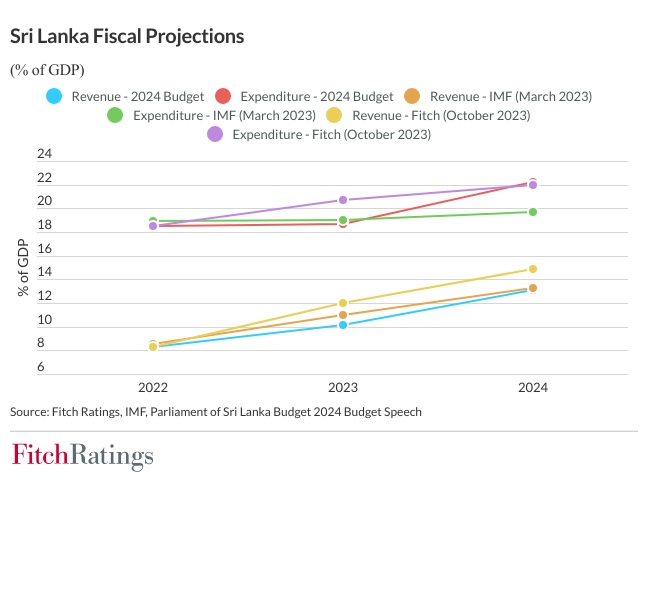
    • While the International Monetary Fund (IMF) projections for 2024 align with Sri Lanka’s primary surplus goal (0.8% of GDP), there are disparities in expenditure targets.
    • The government’s expenditure target for 2024, at 22.2% of GDP, exceeds the IMF’s envisioned 19.7%, and it surpasses the revised budget estimate of 18.7% for 2023.
  3. Uncertain Revenue Generation and Risks:

    • The achievement of revenue goals in 2024 is uncertain, given Sri Lanka’s history of fiscal slippage.
    • Despite a planned 3-percentage-point increase in the value-added tax (VAT) to 18%, there are concerns about revenue collection, especially as it fell 29% short of targets over 9M23.
    • The ambitious target of raising revenue by almost 45% in 2024 poses a considerable risk, and factors like inflation, while contributing, may not provide a robust boost.
  4. Increased Spending and Potential Adjustments:

    • The government’s spending plans for 2024 include a 14% increase in spending on salaries and wages, as well as a substantial rise in capital expenditure, slated to increase by 55%.
    • While increased spending might strain the budget, there is potential for adjustments, especially in capital expenditure, if revenue falls short.
  5. Governance Reforms and Revenue Collection:

    • Sri Lanka’s government aims to implement governance reforms, including the establishment of a new revenue authority under the Ministry of Finance to enhance tax collection.
    • Additionally, a new investment law is proposed to establish a National Economic Commission to promote investment.
    • However, the effectiveness of these reforms will take time to assess, and their impact on revenue collection remains uncertain.
  6. Fitch Rating and Future Outlook:

    • Fitch Ratings currently maintains Sri Lanka’s Long-Term Foreign-Currency Issuer Default Rating (IDR) at ‘RD’ (Restricted Default).
    • The rating is contingent on the completion of a commercial debt restructuring that normalizes Sri Lanka’s relationship with the international financial community.
    • The post-default rating will depend on Fitch’s assessment of Sri Lanka’s credit profile.
In summary, the budgetary landscape for Sri Lanka in 2024 is characterized by a complex interplay of challenges, disparities between government targets and IMF projections, uncertainties in revenue generation, increased spending plans, ongoing governance reforms, and the critical factor of Fitch Ratings awaiting completion of debt restructuring for a potential change in the country’s rating.

Are you worried about your Accounting problems? Leave the numbers and calculations to us

Get in touch with us to take care of your processes allowing you more time to focus on what matters.
Share this post